Radio & CB
How to Talk on the CB Radio Without Sounding Like It's Your First Day
Which channel, what to say first, how long to hold the key, and the handful of rules the FCC actually cares about. Ten minutes and you'll sound like you've been out here a while.
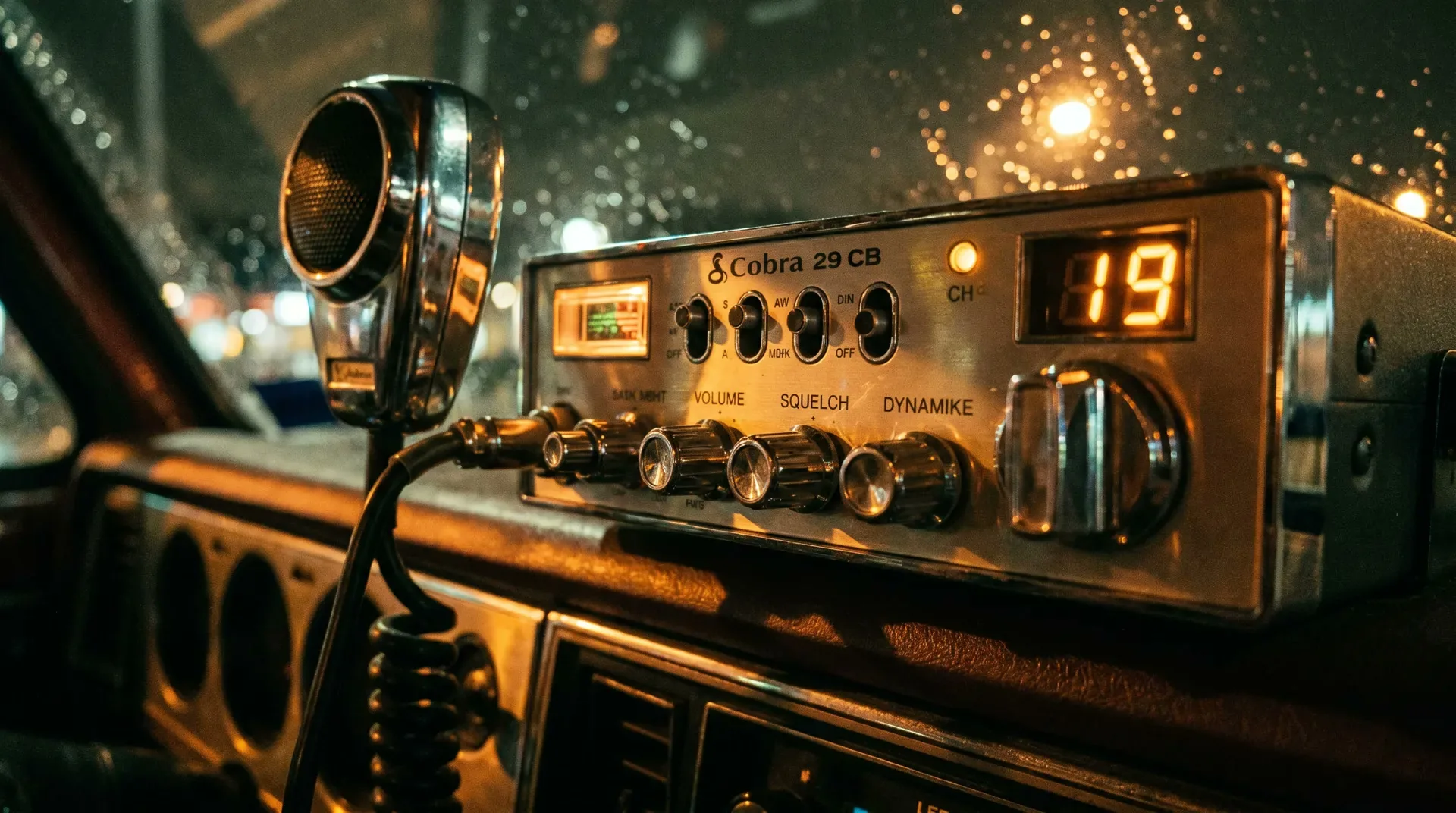
Nobody teaches you this. They hand you a logbook, a fuel card and a truck that costs more than a house, and the radio is just there, bolted under the dash, hissing. So here's how to talk on the CB radio, written down once, plainly, so you never have to ask on the air.
Twenty years and better than a million miles, and the thing I still hear most from new drivers is a long, nervous silence after they key the mic for the first time. It's a button and a voice. You already have both.
First, the short version
- Turn to Channel 19. That's the highway channel. Listen for a full minute before you say anything.
- Wait for a gap. Two people talking is a conversation. Three people keyed up at once is just noise.
- Press, pause, talk. Hold the key, wait half a beat, then speak across the mic, not into it. Let go when you're done. The radio can't hear you and them at the same time.
- Say who you want and what you need. "Breaker one-nine for a radio check." "Eastbound, how's it look behind you?"
- Keep it short, say thanks, get off. Somebody behind you needs the channel more than you need the last word.
Which channel, and why 19
A CB has 40 channels. Only one of them is set aside by federal rule: Channel 9 is for emergencies and traveler assistance, and nothing else (47 CFR 95.931). Leave it alone unless somebody's in the ditch.
Channel 19 isn't in any rulebook. It's the highway channel because drivers made it one, and it stuck. That's where you'll hear about the backup at the 212, the bear sitting in the median, and the lot that still has three spots at eleven at night. If you and another driver want to actually visit, the polite move is "take it to two-one?" and you both move up a couple of channels so 19 stays clear for the road.
What to actually say
You don't need to sound like a movie. You need to be understood the first time. Here's most of what gets said in a day:
- "Breaker one-nine" — I'd like the channel for a second.
- "Radio check" — can anybody hear me, and how do I sound?
- "How's it look over your shoulder?" — what's behind you that I'm about to drive into?
- "10-4" — understood. "What's your 20?" — where are you? "10-33" — emergency traffic, clear the channel.
- "Bear" or "smokey" — law enforcement. "Chicken coop" — weigh station. "Yardstick" — mile marker. "Hammer lane" — the left lane.
- "Appreciate it, driver. Be safe." — the only sign-off you'll ever need.
Direction matters more than vocabulary. "There's a wreck" helps nobody. "Westbound 40 at the 156, right lane's blocked" helps everybody for ten miles. Say which way, say which marker, say which lane.
Your handle
Nobody uses their real name out here and the FCC doesn't ask you to: it stopped licensing individual CB operators back in the early 1980s, so there's no call sign to give. You pick a handle, or the road picks one for you, which is usually worse. Mine's Honey Badger, and I didn't choose it, and no, I'm not telling that story on a public page. Pick something short that survives static. Two or three syllables. If it takes a sentence to explain, it's not a handle, it's a biography.
The rules most people get wrong
CB is "licensed by rule," which means no license, no test, no fee. But there are rules, and they're short. Straight from Part 95, Subpart D:
- Power: 4 watts on AM or FM, 12 watts peak envelope power on single sideband (95.967). The amplifier your buddy swears by is not a gray area.
- Time: keep a conversation to five minutes, then stay off that channel for a minute (95.957). The rule is old and hardly anybody times it, but the manners behind it are the whole point.
- No show business: no music, whistling or sound effects to entertain (95.933). That's what the radio station is for, and I happen to know a good one.
- FM is legal now. The FCC added FM as an optional mode in 2021, so newer radios may have an AM/FM switch. FM is cleaner up close; AM is still what 19 runs on. If nobody answers you, check that switch first.
Make yourself easy to hear
Most "bad radios" are bad habits. Talk across the mic from a couple of inches away, in your normal voice. Shouting just distorts. Set your squelch by turning it up until the hiss just disappears and stopping there; any higher and you'll mute the weak stations, which are the ones far enough ahead to be useful. Leave RF gain all the way up until somebody close is blowing your doors off, then back it down.
And the unglamorous truth: the antenna is the radio. A modest radio on a properly mounted, properly tuned antenna will out-talk an expensive one on a bad mount every day of the week. Any CB shop at a truck stop can check your SWR in a few minutes. That reading tells you whether the power is going out the antenna or coming back down the coax to cook your radio.
Etiquette nobody writes down
- Listen first. A full minute. You'll learn who's on, which way they're headed and whether it's a good time.
- Don't walk on people. If you key up over somebody, neither of you gets through.
- Emergencies own the channel. When you hear "10-33" or "break, break," stop talking. Mid-word if you have to.
- The idiot on 19 wants an audience. Don't be one. Turn it down, not up.
- Say thank you. The driver who told you about the ice didn't have to.
Your first radio check, word for word
You: "Breaker one-nine, how about a radio check?"
Somebody: "Got you loud and clear, driver. Where you at?"
You: "Westbound at the one-sixty. Appreciate it. How's it look over your shoulder?"
Somebody: "Clean and green back to the state line."
You: "10-4. Be safe out there."
That's it. Five lines. You're on the radio now. When the channel goes quiet, and at three in the morning it will, there's a station that doesn't, and a longer argument for keeping that CB bolted in even if your phone does everything else.
Quick answers
Do I need a license to talk on a CB radio?
No. In the United States the CB Radio Service is licensed by rule: you can operate a certified CB radio without an individual license. The rules live in 47 CFR Part 95, Subpart D.
What channel do truckers use on the CB?
Channel 19, by long custom rather than by law. It is where highway traffic, road conditions and backups get talked about. The only channel the FCC reserves is Channel 9, for emergencies and traveler assistance.
What do I say first on a CB radio?
Listen for a gap, key up, and say who you're after or what you need: "Breaker one-nine, how about a radio check?" or "Westbound, how's it look over your shoulder?" Then let go of the key and wait.
How long can I talk on a CB?
The federal rule limits an on-air conversation with another CB station to five minutes, and then you stay off that channel for at least one minute (47 CFR 95.957). In practice: say it short, then let somebody else have the channel.
How far does a CB radio reach?
A legal CB puts out 4 watts on AM or FM and 12 watts peak on single sideband. With a decent, tuned antenna that is usually a few miles on the highway, more over flat open country and less in town. Antenna and tuning matter more than the radio.
Joann Marie is a produced character and the host of Channel 19. Her road is fiction; the rules, numbers and sources on this page are real and linked. Nothing here is a product endorsement, and nobody was paid for a mention.
The Night Run · Sunday nights
One letter a week, for the hours when the radio's the only other voice.
The week's dispatch from the archive, the new story on The Road, and what's spinning on Channel 19. No fees, no spam, one click to leave.
You're on the list. First letter lands on a Sunday night. Until then, the radio's on.
The list isn't wired up tonight. Nothing was lost and nothing was sent. One tap puts you on it by hand:
See the Privacy Policy. Joann Marie is a produced character; the letter is written by the Channel 19 desk in her voice.